If you have discovered the health benefits of a low carbohydrate, healthy fat lifestyle like I have, you have probably heard someone say “you can’t have that, that’s not keto”. That statement can be annoying at times. I just want to say to them “who are you, the Keto Cops”? The longer I maintain and evolve this natural, species appropriate lifestyle, the more I realize they probably have no idea what “keto” is other than a buzzword or a marketing strategy. In addition to the Keto Police in laying the law down, just hearing the the word keto causes some folks to bristle. Let me attempt to shine a little light on what “keto” even means.
In 2020 and 2018 The Keto Diet was the most searched “diet” on the internet and number 6 most searched in 2017. In fact, The Keto Diet has been ranked fairly high in searches for quite some time. Big food companies knowing what you search for guides how their products are marketed. Let’s face it, marketing departments have been doing this forever and now they do it in real time using sophisticated algorithms picking up on your search habits presenting you with adds based on your interests. Do you remember Paleo, Mediterranean, Fat Free, Heart Healthy, Healthy Whole Grain, All natural, Organic, etc…? These are just a few of the buzzwords that food companies use in advertising and put on labels to get your attention. Recently, “Keto” has turned into “Keto Friendly”. What the heck does that even mean??? These attention grabbing buzzwords are used to guide your purchases. You’ve all seen it, you search for or even mention something in front of your phone and before you know it you are getting adds for it. Well, that is what has happened with “Keto”. Keto and Keto Friendly have been used on labels for quite a while now because they are associated with weight loss. Don’t be fooled. Just because the label says “keto” doesn’t mean it is low carb or even remotely healthy for that matter. Now that folks are beginning to look at labels a little more, the term “net carbs” has begun to evolve, as well. Net carbs is a method of subtracting carbs assuming some carbs have no impact on glucose (blood sugar).
The first known use of the term keto was in 1891 however, we have known about ketones since the mid 1850’s. Allow me to dive in a clear things up a little.
Photo by Total Shape on Pexels.com
Ketones
Ketone defined by Merriam-Webster – any class of organic compounds, such as acetone, characterized by a carbonyl group attached to two carbon atoms and are an alternative fuel source derived from fatty acids.
Ketones were first discovered in the mid 1800’s in the urine of patients with uncontrolled diabetes. Since these patients were metabolically dysfunctional, it was assumed that ketones must be bad and a negative connotation was associated with them. A little later in the 1920’s the fasting induced ketogenic (more on ketogenic a little later) diet was being used to very successively treat children with epilepsy. The ketogenic diet dramatically reduced seizures in lots of patients. In fact, treating seizures with fasting goes back to 500 B.C. We now know that it was more than likely the ketones that were keeping the seizures at bay. Based on some recent studies, it seems like the brain loves ketones. This method of treatment would continue for two decades until the development of anti-epileptic drugs. Since there is no money in fasting or eating healthy, treating seizures with drugs soon overshadowed the fasting method even though fasting works much better in some patients. Ketosis and exogenous ketones are being looked at again for the treatment epilepsy in children, as well as adults.
Ketones are a perfectly normal chemical made by the liver. The body is constantly making small amounts of ketones that can create 22 ATP each. ATP is an organic compound that provides energy in living cells at the molecular level such as muscle contraction and nerve impulses. Below is a diagram of how the body makes ketones.
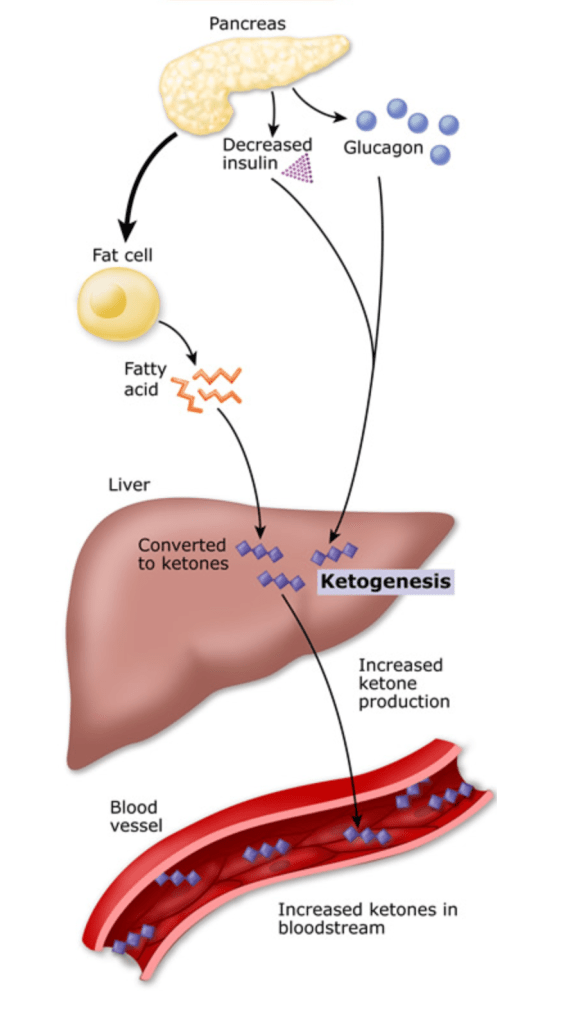
Ketogenesis
Ketogenesis is a metabolic pathway that produces ketone bodies which provide an alternative fuel source for the body. Ketogenesis produces acetone, acetoacetate and beta-hydroxybutyrate by breaking down fatty acids.
When carbohydrate consumption is reduced from eating less carbs or eating less often, glycogen stores deplete, forcing the body to go through certain metabolic changes. Two metabolic processes come into action when there is low carbohydrate availability in body tissues: gluconeogenesis (the bodies way of making blood glucose) and ketogenesis.
Regulation of Ketogenesis
Ketogenesis can be up-regulated by hormones such as glucagon, cortisol, thyroid hormones, and catecholamines by causing a more significant breakdown of free fatty acids, thus increasing the amount available to be used in the ketogenic pathway. However, insulin is the primary hormonal regulator of this process. We have to keep the carbs down preventing insulin elevation for this to happen.
Insulin regulates many key enzymes in the ketogenic pathway, and a state of low insulin triggers the process of ketogenesis. Insulin levels remain elevated if we are constantly eating carbohydrate rich foods therfore preventing the production of ketones.
A low insulin state leads to:
- Increased free fatty acids (FFAs) from our fat cells
- Increased use of FFAs in the mitochondria
- Increased production of ketone bodies
Ketogenic
A ketogenic lifestyle consists of eating in a way that promotes the bodies production of ketones either through what is eaten or the timing of the meals. The macro content of a ketogenic diet primarily consists of high, healthy fats, moderate proteins, and very low carbohydrates. The production of ketones may also be propagated by intermittent fasting or longer fasts which is an easy way of reducing carbohydrate intake and reducing insulin levels.
Russel Wilder first used the ketogenic diet to treat epilepsy in 1921. He also coined the term “ketogenic diet.” For almost a decade, the ketogenic diet enjoyed a place in the medical world as a therapeutic diet for pediatric epilepsy and was widely used.
The next time The Keto Cops try to tell you that what you are eating is “keto” or not you will have a little better understanding of what “keto” even means. Hope this helps.
Let me know what you think by leaving a comment. If there is a particular topic you would like to read about, let me know that, too.
Thank you for your time,
Jim Nutter
 A Little Harder To Kill
That’s very helpful!
LikeLiked by 1 person